
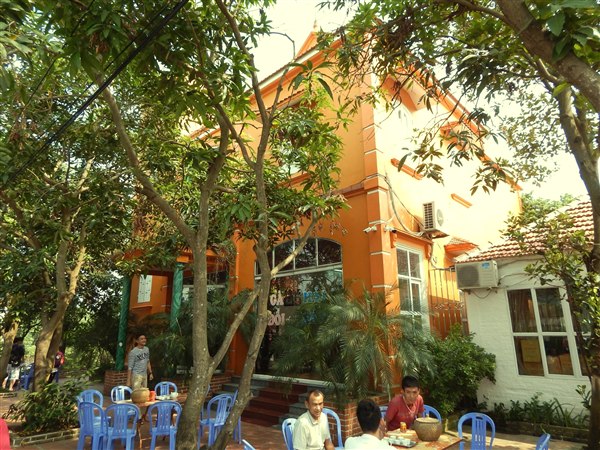
Plastic tables and chairs under the trees
After eating, guests would go out to the yard to drink a cup of tea, enjoying the breeze under the tree shade — that spot still has the tree and the tea pot today.
Two generations keeping a kitchen in the ancient capital
There are eateries that open when they see tourists flocking in. Our restaurant has been here since before that — from the days when Tràng An was still quiet, the road to the ancient capital was still small, and most of the diners were locals. It's been over twenty years, the person who set up the kitchen back then now has gray hair, the children and grandchildren have taken over, but the goat is still chosen as before, the broth is still simmered with the same fire, the meat is still sliced by hand. We tell our family's story here, simply, as we still tell it to regular guests over a pot of tea at the end of a meal.
In the early 2000s, our family set up a small kitchen by the road leading to Hoa Lư. Back then, there wasn't the bustling Tràng An boat station as there is now; the guests were locals, long-distance drivers, a few groups visiting the temples of King Đinh and King Lê. The kitchen was cramped, with a few sets of wooden tables and chairs, cooking exactly the dishes people in Ninh Bình eat at home: mountain goat meat, crispy scorched rice, hill chicken, vegetables picked from the garden. Everyone who stopped by was offered a cup of hot tea before sitting down — a habit that continues to this day.
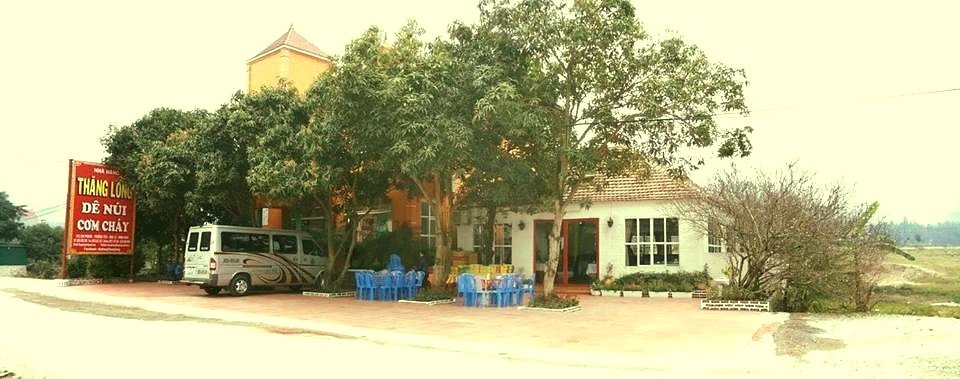
More than twenty years have passed, this area has become a major tourist destination, and the restaurant has expanded to accommodate up to a thousand guests. However, the things we brought from the beginning remain the same: carefully selected goats, a broth simmered just right, and a business ethic that doesn't focus on just one season. The kitchen has grown, but the heart of those who cook remains unchanged.
We don't have many photos from those days — everyone was busy working, rarely thinking about taking pictures. We have a few left, and we share them here so you can see what the restaurant was like back then.
After eating, guests would go out to the yard to drink a cup of tea, enjoying the breeze under the tree shade — that spot still has the tree and the tea pot today.
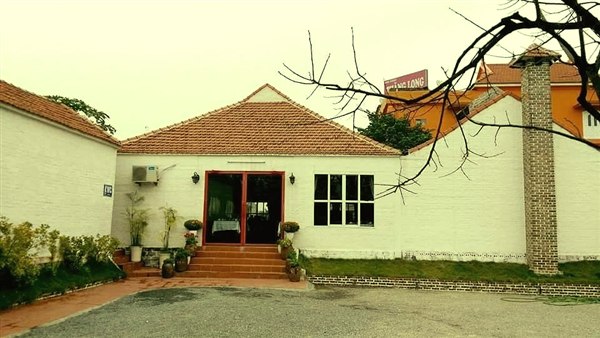
Red tiled roof, whitewashed walls, red-painted wooden doors — a familiar style of house construction in this region.
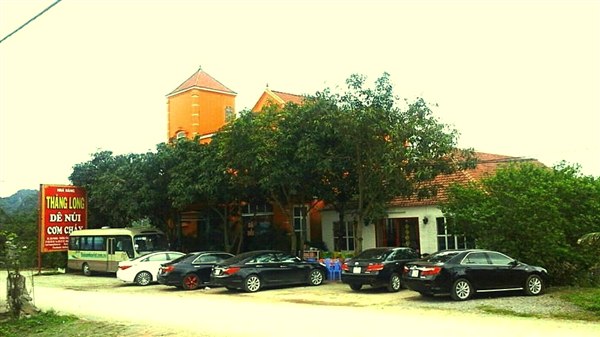
Passenger buses parked next to a few cars, with the rocky mountains behind. The parking lot back then could only hold about 20 cars; now it has expanded to accommodate 50–60 cars at once.
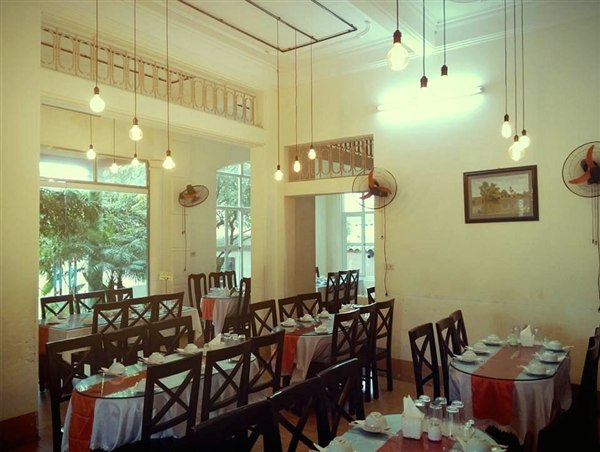
Wooden tables and chairs, white tablecloths, tea sets neatly arranged from early morning — the kitchen opens at seven in the morning, a habit that hasn't changed a single day.
Documentary photos kept by the restaurant — real photos taken at the restaurant, only colour adjusted for eye comfort, not staged and nothing added or removed from the frame.
The restaurant stands on the land of ancient Trường Yên, where King Đinh Tiên Hoàng established the Hoa Lư capital of Đại Cồ Việt in the 10th century. A few minutes by car from the restaurant are the temples of King Đinh and King Lê — where the stone dragon bed, a treasure known to every Ninh Bình resident, is kept.
The name Thăng Long means dragon rising. The previous generation named their eatery not to sound grandiose. The dragon in the heart of the Vietnamese is a symbol of origin, of rising — and within it is a very simple wish: if we conduct our business properly, our descendants can continue to stand on this land.
Sitting in the restaurant, looking out at the rocky mountains, turning back to the temples of a thousand-year-old capital. Cooking in such a place, one naturally feels they must not be careless.

The limestone mountains of Hoa Lư naturally raise free-grazing goats. The goats climb rocks year-round, so the meat is lean, low in fat, firm, and sweet — those familiar with the taste can tell immediately if it's mountain goat or not. We have kept one principle from the beginning: the goat meat here is mountain goat, not mixed with other meats. It's easy to say in a few words, but maintaining it for over twenty years is what matters.
From that goat, the kitchen creates all the dishes of the ancient capital: goat with lime and sesame (dê tái chanh), steamed with lemongrass, steamed with perilla at the table, grilled in chunks, grilled on an iron plate, stir-fried with lemongrass and vinegar, braised with vinegar, salt-roasted, goat spring rolls, goat hotpot — each dish with its own way of eating, its own leaves, its own dipping sauce. Accompanied by crispy scorched rice drizzled with hot sauce, a dish born from the scorched layer of rice at the bottom of the cast iron pot of the local countryside — something that once no one thought would become a specialty to treat guests from afar.
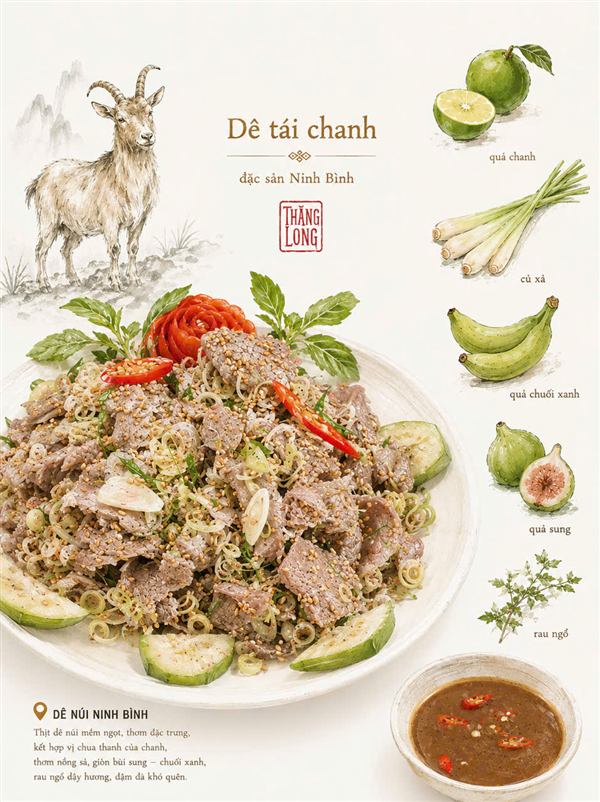
Dish photos — illustrations redrawn from actual photos taken at the restaurant. (tranh vẽ lại từ ảnh chụp thực tế)
The most familiar starter — thinly sliced meat mixed with lime, lemongrass, lime leaves, and roasted sesame; wrapped in fresh fig leaves, served with green banana, starfruit, sliced pickled figs, and bần soy sauce.
See how to eat →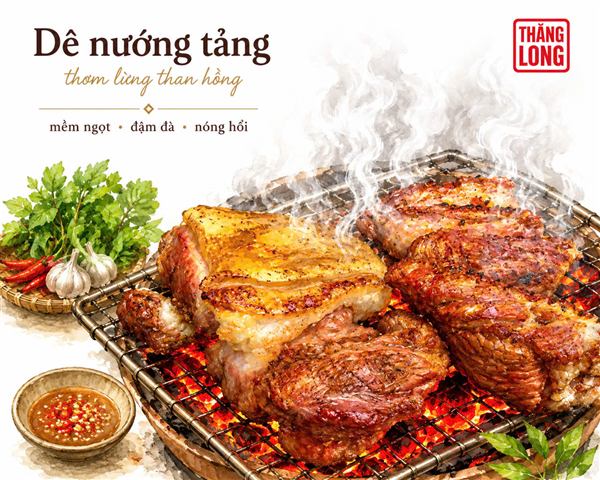
Dish photos — illustrations redrawn from actual photos taken at the restaurant. (tranh vẽ lại từ ảnh chụp thực tế)
Grilled in chunks and then sliced at the table for guests, retaining the sweetness in the meat fibers.
See how to eat →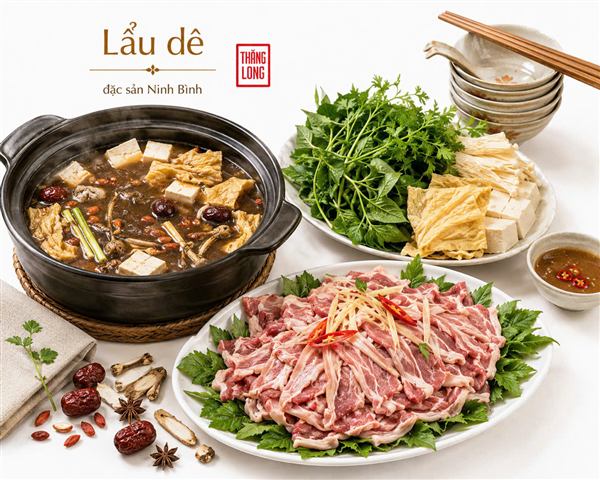
Dish photos — illustrations redrawn from actual photos taken at the restaurant. (tranh vẽ lại từ ảnh chụp thực tế)
A hotpot for the whole family to gather around — broth simmered from goat bones, medicinal herbs, and roasted ginger.
See how to eat →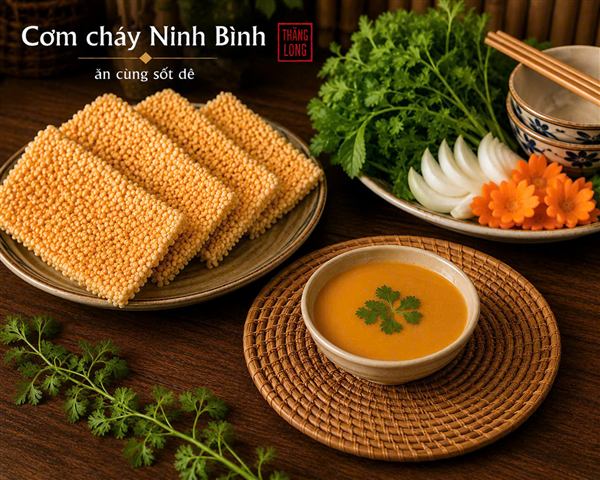
Dish photos — illustrations redrawn from actual photos taken at the restaurant. (tranh vẽ lại từ ảnh chụp thực tế)
Crispy scorched rice drizzled with hot sauce served immediately at the table — something that was once just the scorched layer of rice at the bottom of the cast iron pot of the local countryside.
Learn about crispy scorched rice →The kitchen trade now has many ways to speed things up. We know them all, but we don't use them. The meat is still hand-sliced, the broth still simmered for the right amount of time, fig and lime leaves still picked in season, bần soy sauce still sourced from the familiar place for decades. Some dishes are so elaborate that guests have to wait an extra ten minutes — we'd rather ask guests to wait than serve a dish that doesn't resemble what we usually make.
The previous generation instructed the next with just one sentence, sounding rustic but sufficient for a lifetime: cook for guests as if cooking for your own family. In the kitchen today, there are still people who have been in the trade since the restaurant was small, now with gray hair; some started when their children were still infants, now their children also help in the kitchen. The restaurant has grown alongside several families like that.
We publicly list the prices of 95 dishes on the menu page for you to view at home, and keep those prices stable year-round: no price hikes during peak season, no different prices for guests from afar. For large groups, there are set menus from 150,000đ to 500,000đ per person, with prices clearly stated before the group arrives.
Honestly, doing business in a tourist area while keeping prices stable means thinner profits. But this restaurant has survived for over twenty years thanks to returning customers, thanks to one group recommending to another — things that only happen when people see that we conduct ourselves properly, not because of a busy summer season. We want guests to leave the table feeling well-treated, not feeling like they just paid for a name.
There's one thing we've noticed clearly in recent years: guests come not just to eat their fill. Many young people from Hanoi, from the South, sit down and ask how this dish is cooked, why mountain goat is different from farmed goat, what the painting on the wall depicts. They want a meal with roots, with stories to tell — not just a quick meal to get by, to have enough.
Foreign guests are the same. Those who travel halfway around the world to Ninh Bình mostly want to touch the real: sitting in a house with a tiled roof, hearing the dish names in Vietnamese, watching the steaming pot being opened right in front of them, asking why the restaurant is named "dragon rising." For them, the meal is part of the journey to explore Vietnamese culture, not just a stop to fill their stomachs between two tourist spots.
We are glad for that, and also feel a sense of responsibility. When people seek out the roots, we must not deviate from the roots: dishes must keep the old way, the space must retain its simplicity, the stories told must be the true stories of this land.
At lunchtime, the restaurant usually has a mix of everyone: tour groups just off the Tràng An boats, families bringing grandparents to the temple, young people riding motorbikes from Hanoi to find old dishes, and foreign guests brought in by guides. Familiar faces and strangers sit together in one hall, laughter mixed with the sounds of bowls and chopsticks — that's the atmosphere we cherish most in this trade.
Travel companies. Many large and small travel agencies with Ninh Bình tours have been bringing groups here for many years. They need a place spacious enough, a kitchen that serves dishes on time for hundreds of guests at once, and prices quoted in advance without changes — we've maintained these three things, so they keep coming back. Travel companies.
Individual guests and young people. Many young people come not because the restaurant is new, but because it's the opposite — they want to eat what has been here for twenty years. For us, that's a great joy: the old still has people seeking it out.
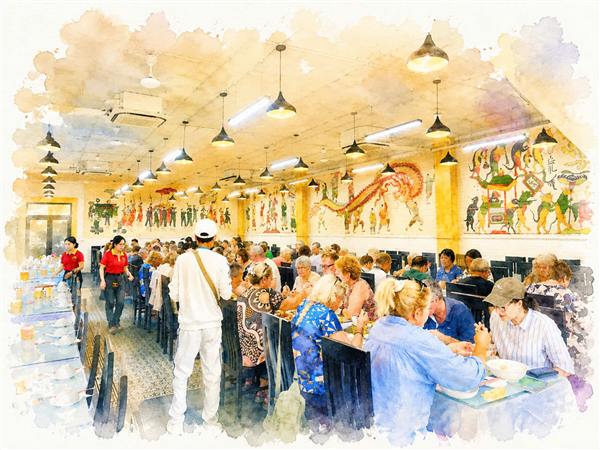
Restaurant space photos — illustrations redrawn from actual photos taken at the restaurant. (tranh vẽ lại từ ảnh chụp thực tế)
The large hall is set with long tables, dishes served in portions for the whole group to eat at once. Guests ask for dish names, ask how to eat — the restaurant always has someone to explain.
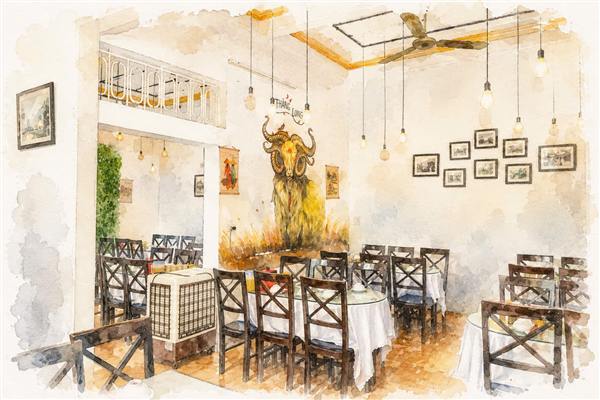
Restaurant space photos — illustrations redrawn from actual photos taken at the restaurant. (tranh vẽ lại từ ảnh chụp thực tế)
Private room for families with elderly or young children — quiet, allowing for a longer stay.
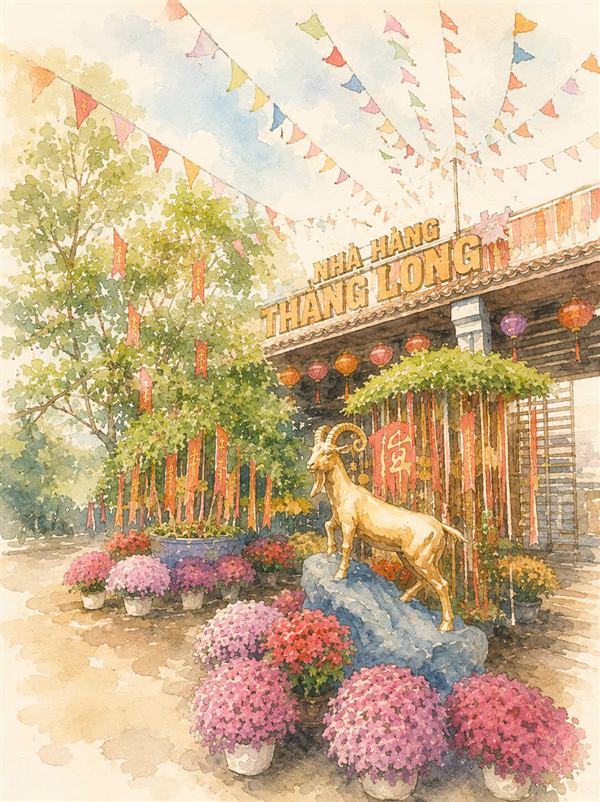
Restaurant space photos — illustrations redrawn from actual photos taken at the restaurant. (tranh vẽ lại từ ảnh chụp thực tế)
Regular guests often arrange to meet "at the place with the bronze goat" — a landmark for the restaurant for many years.
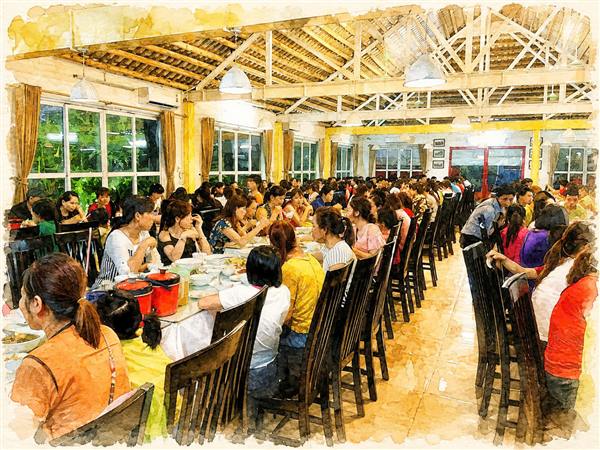
Restaurant space photos — illustrations redrawn from actual photos taken at the restaurant. (tranh vẽ lại từ ảnh chụp thực tế)
The large hall is packed, laughter mixed with the sounds of bowls and chopsticks — that's the atmosphere we cherish most in this trade.
The restaurant has a total capacity of 1,000 guests at a time, divided into large halls and private rooms; the parking lot can accommodate 50–60 vehicles at once, both cars and buses. There is WiFi, air conditioning, and karaoke rooms for group parties. But on regular days, a couple stopping by for lunch still has a quiet corner — for us, a table for two or a table for two hundred must be cooked the same way.
Open 07:00–22:30 daily, year-round. On holidays and Tết, the kitchen is still open; we just hope you call an hour ahead so we can prepare thoroughly.
If you have the chance to visit the ancient capital, we invite you to sit with us for a meal — to know how sweet real mountain goat can be, and why this house has kept the same cooking style for over twenty years.
Tràng An, Chi Phong village, Tây Hoa Lư ward, Ninh Bình province (on the Tràng An – Bái Đính road, a few minutes by car from the Tràng An boat station)